New Publication: MorphGUI, real-time GUIs customization with large language models

We are pleased to announce the publication of our article, MorphGUI: Real-Time GUI Customization with Large Language Models in the Elsevier International Journal of Human-Computer Studies (IJHCS). Authored by Tommaso Calò, Andrea Sillano, and Luigi De Russis, the work introduces MorphGUI, a novel framework designed to change how users personalize graphical user interfaces. The framework was evaluated through a use-case implementation with a calendar application and a user study involving 18 participants.
Traditional customization tools rely on predefined configuration settings, often restricting user flexibility and requiring technical expertise. MorphGUI lowers these barriers by allowing users to customize interfaces simply by describing their desired changes in natural language without altering the application's core functionalities. The AI assisted customization process starts in the Enhance With AI panel, it offers component level targeting for modifying or adding UI elements. Users specify What it should do to define the element's functional behavior and How it should appear to control its styling and layout. Finally, the panel provides three main actions: Generate to apply the defined changes, Previous to roll back to a previous configuration, and Restore to return the interface to its last stable state.
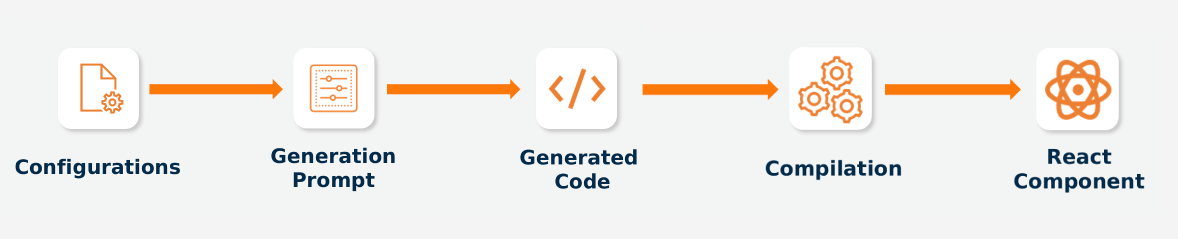
Behind the scenes, MorphGUI combines user inputs, component context, and system constraints into structured prompts sent to the LLM. The model’s output is validated and converted into executable interface code. A dynamic component handles dependency resolution, compilation, and rendering, enabling the updated interface to appear immediately and supporting a seamless, iterative workflow.
We conducted a user study with 18 participants evaluating MorphGUI’s usability and effectiveness using a calendar application as a testbed. Participants were asked to complet two tasks one simple visual adjustments the other a complex combinations of functional and stylistic changes.
Overall, the system was perceived as intuitive, well-integrated, and easy to learn. Usability scores and Likert-scale responses indicated low cognitive effort and high user confidence. Importantly, familiarity with LLMs did not influence performance, suggesting that MorphGUI is accessible even to those without prior experience with generative AI.
Additional information: